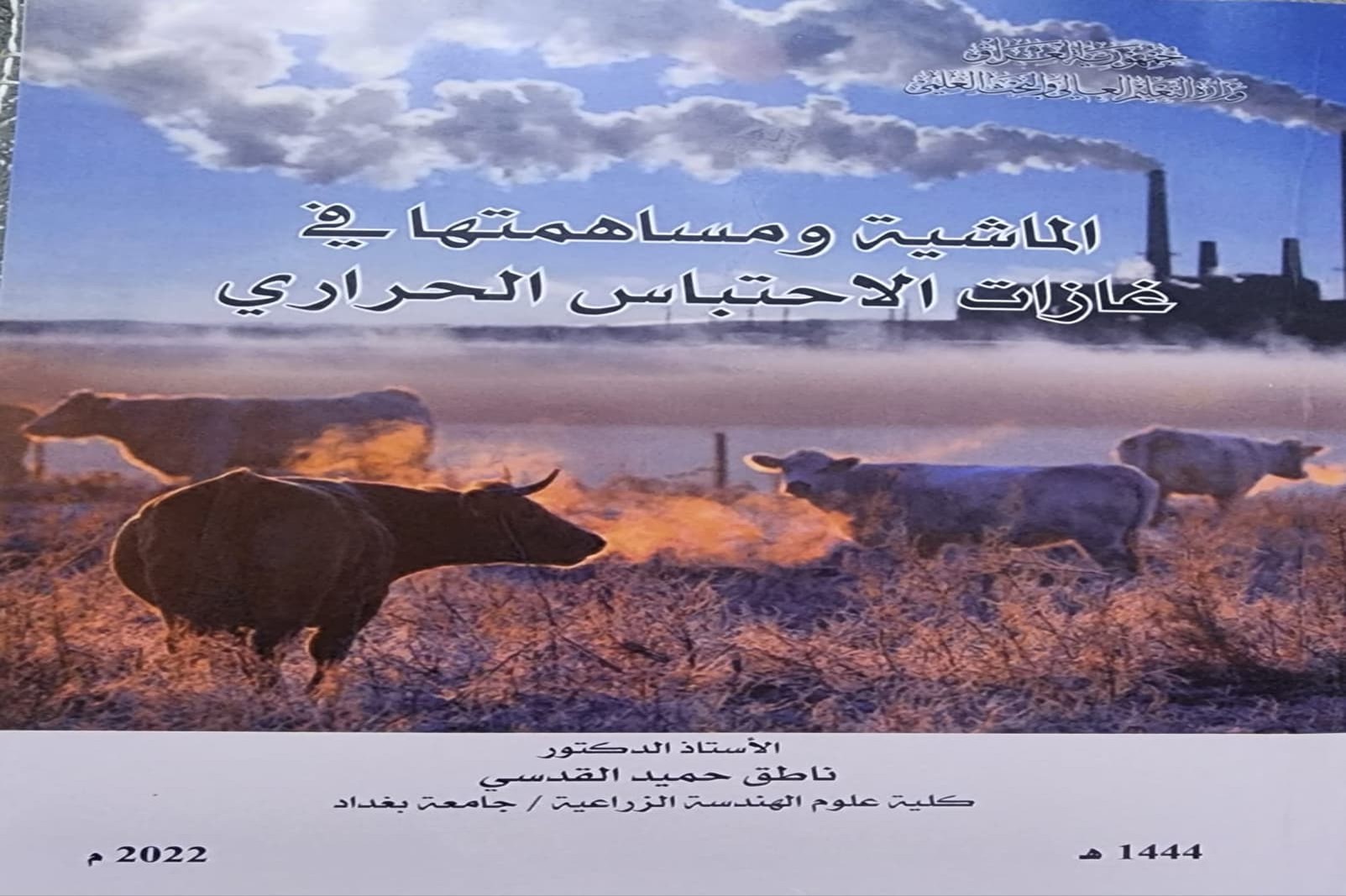
Book Release: “Livestock and Their Contribution to Greenhouse Gas Emissions”
Authored by Prof. Dr. Natiq Hameed Al-Qadisi, an expert in Animal Production at the College of Agricultural Engineering, University of Baghdad.
Authored by Prof. Dr. Natiq Hameed Al-Qadisi, an expert in Animal Production at the College of Agricultural Engineering, University of Baghdad.
This seminal work supports the Sustainable Development Goals (SDGs) in Quality Education by providing a comprehensive scientific reference for both graduate and undergraduate students.
The 300-page book, organized into seven chapters, examines greenhouse gases (GHGs) and livestock‘s role in their emission. It begins with a detailed analysis of key GHGs—carbon dioxide (CO₂), methane (CH₄), and nitrous oxide (N₂O)—explaining their properties and environmental impacts. Subsequently, it explores livestock’s contribution to these emissions through biological processes, particularly microbial fermentation in the rumen.
The book highlights the biological sources of methane from livestock, detailing how anaerobic digestion releases significant quantities of this potent gas. It emphasizes that emission levels vary based on feed type, farm management practices, and herd size, underscoring the complexity of the issue and the need for ongoing research. Notably, the text clarifies that methane’s global warming potential far exceeds that of carbon dioxide.